Celtic knot and triskelion earrings
Celtic silver earrings are 925 sterling silver ear ornaments engraved or cast with interlace knots, triquetra loops and triskelion swirls, the 3-armed spiral that first appears in Insular art of the 6th to 9th centuries. Sold in the UK as studs, drops and lever-backs, they run from a 2 gram stud to an 8 gram drop and are stamped 925 on the back of the silver, the hallmark that certifies 92.5% silver content. The designs borrow directly from the Book of Kells, the Lindisfarne Gospels and carved stone crosses, and a pair typically costs between 35 and 120 pounds at UK jewellers.
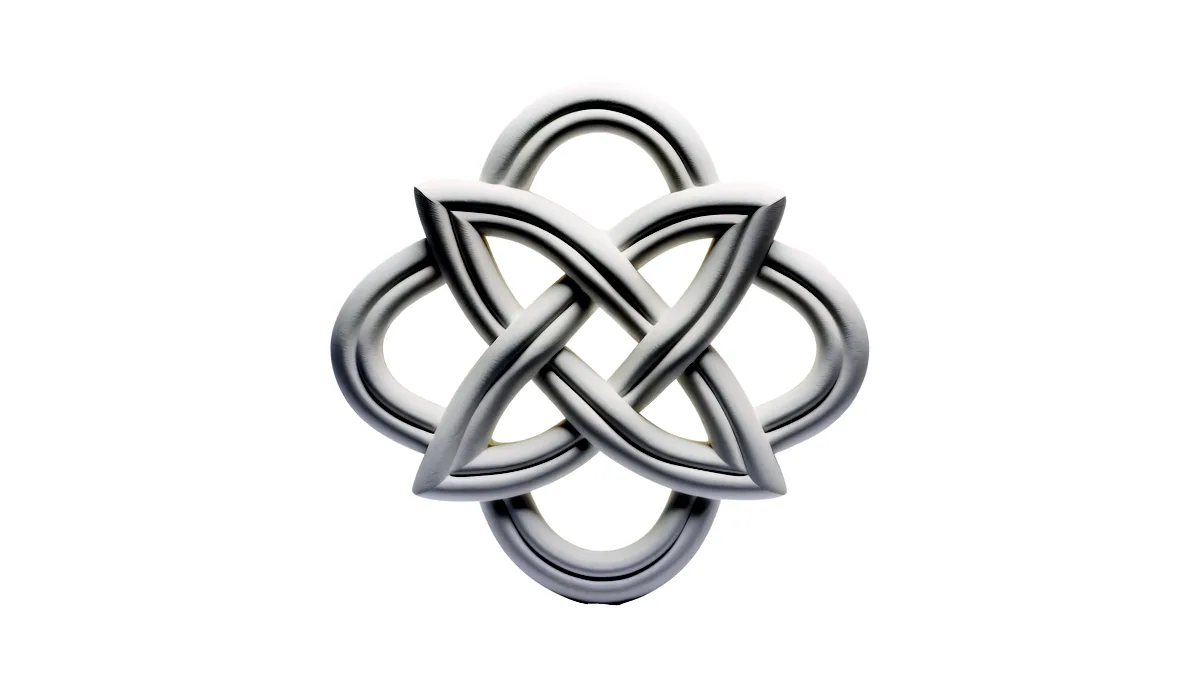
Buyers searching for 925 sterling silver earrings in the UK will find these motifs most often in two metal finishes: bright polished silver and oxidised blackened silver, where the recesses of the interlace are darkened so the raised strands read clearly at arm's length. The same interlace patterns also appear in Celtic silver rings, and many makers cut the identical knotwork from one die set, so a triquetra stud and a triquetra ring share a single line drawing. That shared source is the reason the earrings and the rings sit in the same display tray in most UK silver shops.
What the 925 stamp actually certifies
The 925 stamp certifies that the earrings contain 92.5% silver by weight and 7.5% alloy, almost always copper, which raises the hardness of the metal so a knotwork stud survives daily wear. UK law, enforced by the Assay Office of the Hallmarking Council, requires the 4-point hallmark on articles over the exemption threshold of 7.78 grams, so a single drop earring that weighs 4.5 grams can carry the 925 stamp alone without the lion, the leopard's head or the date letter, while a heavier drop over 7.78 grams must also carry the town mark. The number 925 therefore does 2 jobs: it fixes the purity at 92.5% and it sets the weight at which the full UK hallmark becomes mandatory.
The 3 symbols on a pair of earrings
The 3 symbols that recur on Celtic silver earrings are the interlace knot, the triquetra and the triskelion, and each carries a different visual load.
| Symbol | Line structure | Typical earring use |
|---|---|---|
| Interlace knot | Continuous over-under weave, no start or end point | Band around a stud or the body of a drop |
| Triquetra | 3 interlocked vesica loops in a triangle | Centre of a stud, 6 to 9 mm across |
| Triskelion | 3 spirals radiating from one centre | Free-hanging drop or the back disc of a stud |
Readers comparing the two spiral forms should note the direction: the triquetra is a closed triangle of 3 loops, while the triskelion is an open rotation of 3 arms. The distinction matters at the counter, because a 7 mm triquetra stud and a 7 mm triskelion drop weigh differently even from the same maker, and the triskelion's open arms cast a shadow on the neck that the closed triquetra does not.
Stud versus drop in 925 silver
Stud earrings hold the 925 sterling silver closest to the earlobe, and that is the reason they dominate the UK market for knotwork: a 2 gram stud with a 6 mm triquetra sits under the hairline and survives a full working day, whereas a 5 gram drop hangs 18 to 22 mm below the lobe and swings with every turn of the head. The 2 styles differ in 3 ways that a buyer can test in hand.
- Weight: a stud typically weighs 2 to 3 grams per earring, a drop 4 to 8 grams, and the 5 gram gap is felt within a minute of wearing.
- Visibility: the stud reads at 1 m or less, the drop reads across a room, so the drop suits a 30th or 40th birthday and the suit a daily rotation.
- Fitting: the stud takes a 0.8 mm post through a standard 1.5 mm lobe piercing, while a lever-back drop locks over the post and holds the heavier triskelion without stressing the lobe.
When a pair of 925 sterling silver earrings is sold as a matching set, the stud and the drop are cut from the same interlace die, which is why a 6 mm knot stud and its 20 mm knot drop align strand for strand when held side by side.
How the knot is made from one line
Every interlace on a Celtic silver earring begins as a single continuous line drawn on a grid of 10 mm squares, and the over-under crossings are decided before the metal is ever touched. A maker lays the line out on tracing paper, numbers each crossing from 1 to 40 or more, and only then cuts the brass die. The die strikes the 925 sheet in a single 2 tonne press stroke, and the oxidising bath, a 60 second dip in liver of sulphur, fills the recessed strands with a black tarnish that the polish brings back to bright silver along the raised edges. The 2 finishes, bright and blackened, therefore come from the same die and the same 925 blank, separated only by whether the polish is rubbed out after the dip.
Price, weight and wear in the UK market
UK prices for these earrings track the 2 variables of weight and finish, and the spread is wide enough to justify a 3-way comparison before buying. A polished 2 gram triquetra stud sits at 35 to 45 pounds, a blackened 4 gram knot drop at 55 to 80 pounds, and a triskelion pair in lever-back at 70 to 120 pounds, the upper figure reached only when the triskelion is 22 mm or longer. The 925 sterling silver earrings at the top of that range are the ones hallmarked in full, because the drop passes the 7.78 gram threshold and carries the lion, the date letter and the 925 in one cluster on the back. Care is a 2-step routine: a soft cloth after each wear to stop tarnish building in the interlace, and a 925 polish once a year to lift the blackening on a bright-finish pair without touching a deliberately oxidised one.
The knot, the triquetra and the triskelion each keep a fixed place in the UK silver trade, and the 925 stamp on the back of the earring is the single mark a buyer checks first, before the symbol, before the finish and before the price.