Sterling silver chains for necklaces
A 925 silver necklace chain is a chain made of 925 sterling silver, an alloy that is 92.5% pure silver by weight and 7.5% copper for hardness, and it is sold as a length of chain you wear alone or hang a pendant from. The 925 stamp is the trade mark of that 92.5% purity, and the standard lengths, widths and weaves are set out below so you can pick the right chain for a pendant, a lock, or a layering set.
Shop4silver.co.uk is a new, unaffiliated project that restores the former shop4silver address for UK customers; it is not connected to the previous owner. That shop sold Sterling silver necklaces, shipped across the UK alongside its chains, and this page is the chain reference that sits next to the rest of the range, from Silver locket necklaces to Necklace and earring sets in 925 silver and 925 sterling silver rings.
What 925 silver means on a chain
A 925 chain is stamped with its purity, so the figure travels with the piece. Sterling silver is 92.5% silver and 7.5% copper, a blend that has been the UK and US standard for silver jewellery since the Assay Office system formalised the .925 standard in England in 1300. The copper is not a defect; pure silver is too soft for a chain that bends at a clasp every day, and the 7.5% alloy is what lets a cable chain carry a pendant without kinking. When you buy a chain, look for the 925 or .925 stamp on the clasp or the tag, and treat the stamp as the test: it tells you the alloy ratio, the price point, and the care a chain needs. The 2 main properties the alloy buys you are strength and tarnish behaviour, and both of them decide how a chain wears year after year.
Chain lengths and where each one sits
A chain length is measured in centimetres or inches from clasp to clasp, and the number decides the neckline the chain rests at, so match the length to the pendant you intend to hang.
| Name | Length (cm) | Length (in) | Wear point |
|---|---|---|---|
| Choker | 35-38 | 14-15 | Sits on the collarbone |
| Princess | 45-50 | 18-20 | Just below the collarbone |
| Matiere | 50-55 | 20-22 | Middle of the chest |
| Opera | 70-90 | 28-36 | Bust line, or doubled as a choker |
The 18 cm and 45 cm chains are the workhorses for pendants, because a princess length keeps a small pendant at the neckline and a matiere length gives a larger piece room to sit flat against the chest. A 75 cm opera chain is the length that layering sets build around, since it can be worn long or wrapped to a choker with no extra hardware.
Choosing a length for a pendant
Size the chain to the pendant drop first: a pendant with a 2 cm bail needs a 45 cm princess chain to sit at the collarbone, while a 6 cm medallion reads better on a 50 cm matiere chain so its weight does not pull the chain up. If you buy the chain bare, add the bail to the length you want finished, and the pendant length you get is the chain length plus the bail.
Chain width and how heavy it can carry
A chain width is the thickness of a single link measured in millimetres, and that width is the load limit you match to the weight of whatever hangs from it, because a chain that is too fine for its pendant will stretch at the jump ring.
| Width (mm) | Best for | Safe pendant weight |
|---|---|---|
| 1 | Worn alone, as a choker accent | A 3 g tag or small lock |
| 1.5 | Everyday pendant chains | A 5 g locket |
| 2 | Daily wear with a medium pendant | An 8 g medallion |
| 3 | Statement pendants and doubled chains | A 15 g cross or crest |
Width also changes the look: a 1 mm chain reads as a whisper at the neck, a 2 mm chain reads as a statement, and a 3 mm chain reads as jewellery rather than a setting. If you are adding a pendant to an existing chain, check the width of the jump ring as well, because a 2 mm jump ring on a 1 mm chain is the usual point where a light chain fails under a heavy pendant.
Chain weaves and how each one behaves
A chain weave is the pattern the links are forged and closed into, and the weave decides how the chain hangs, how it kinks at the clasp, and how much wear it survives before a single link opens, so pick the weave to the use you will put the chain to.
- Cable: the classic oval links, and the weave to choose when a pendant hangs, because it flexes evenly
- Box: square links set at 90 degrees, and the weave that sits flat and reads as the most modern finish
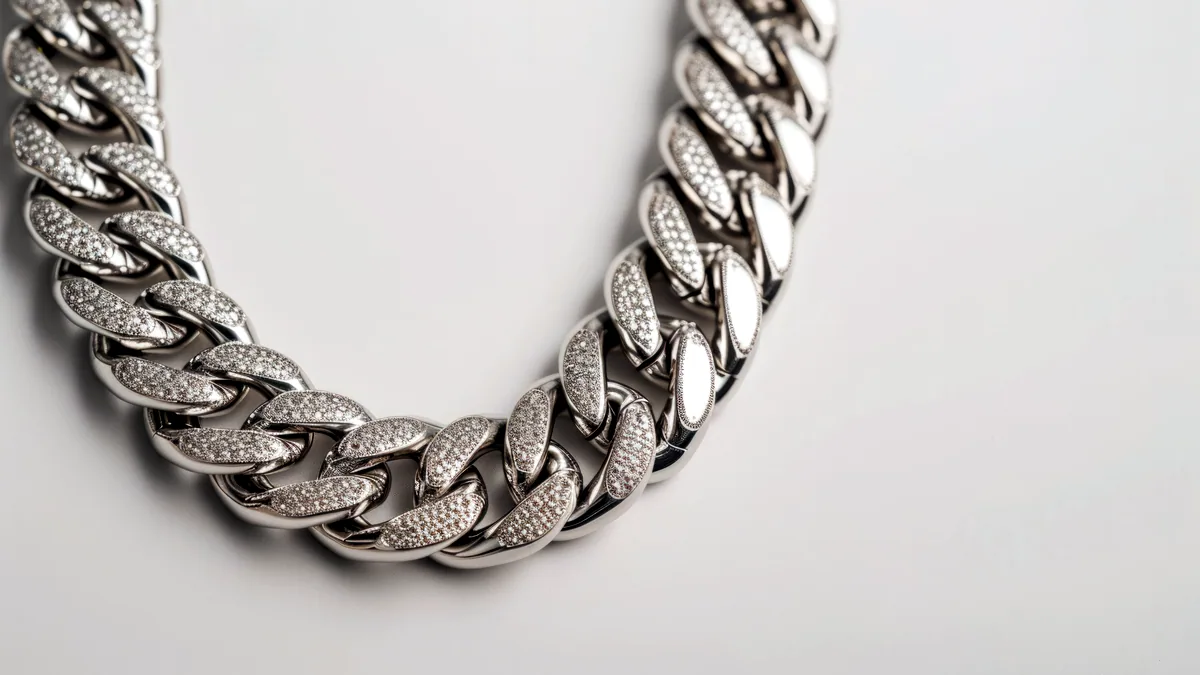
- Curb: flattened links laid flat, and the weave that catches the most light and looks heaviest for its weight
- Figaro: a 3 small, 1 large link pattern, and the weave that sits between cable and box
- Byzantine: interlocking rings that form a woven band, and the weave that is the most kink-resistant of the 5 above
A cable chain is the right first chain for a pendant, a box chain is the right chain to wear alone at a 2 mm width, and a byzantine chain is the right chain for a daily-worn piece that will be clipped on and off in a hurry, because its closed rings take the kink load without a single link taking the full bend.
Buying a 925 silver chain to wear or to hang a pendant from
A 925 chain bought bare costs less than the same chain sold with a pendant, and the bare price is the part that scales with the length, width and weave you choose, so the buying decision is really a length, width and weave decision with a pendant added later. The 3 checks that separate a chain you keep for years from a chain you replace are the 925 stamp, the clasp, and the way the chain is closed at the loop where a pendant hangs. The clasp should be a lobster claw or a spring ring that closes with a click you can feel through the clasp, and the loop where the pendant hangs should be a solid jump ring, not a folded wire, because the folded wire is the first thing to open under a pendant load. A chain sold in a sale is still 925 silver at 92.5% purity, so a reduced price does not lower the silver content, and the sale is a discount on the work and the metal price, not on the assay. If you are adding a pendant to a chain you already own, buy the pendant first, measure its bail, and then match the chain width and length to the bail, so the pendant sits where you want it without a jump ring that is too large or a chain that is too fine to carry it.
Caring for a 925 silver chain
A 925 chain is cared for by keeping it dry, storing it flat, and polishing it on schedule, because the 7.5% copper in the alloy is the part that tarnishes when it meets the air, and the care you give the chain is the care you give that 7.5%. Tarnish on a 925 chain forms as a thin grey film over weeks of wear, and it comes off with a silver cloth in 30 seconds of light pressure, so a cloth is the only tool a chain needs for everyday upkeep. Store the chain flat in a soft pouch rather than hanging it, because a 2 mm chain hanging from a hook will set a kink at the clasp within a few weeks, and a kink is the first sign that a cable chain is about to open at the weakest link. If the chain has been worn with perfume on, wipe it with the cloth before it goes in the pouch, because the alcohol in perfume accelerates the tarnish on the copper side of the alloy. A chain that has been polished with a cloth and stored flat in a pouch will look as new in 2 years as it did the day you bought it, and the 925 stamp will still be legible under the polish, because the stamp is struck into the metal and does not wear away with the finish.