Celtic silver rings
Celtic silver rings for men are sterling silver bands engraved or cast with interlaced knotwork patterns drawn from a 1,500-year-old island art, and the same 925 silver range also serves women in thinner bands and stacked sets. The word "Celtic" is a modern name for the knot and cross designs carved by island artists from roughly 500 AD to 1200 AD, and today the range is sold as 2.0 mm, 2.5 mm and 3.0 mm bands, most of them solid 925 sterling silver rather than plated base metal. The range spans 4 knot styles, 14 band widths from 2.0 mm to 10.0 mm, and 925 sterling silver at 92.5% fine silver. Two anchors define the collection: the endless knot, and the Celtic cross.
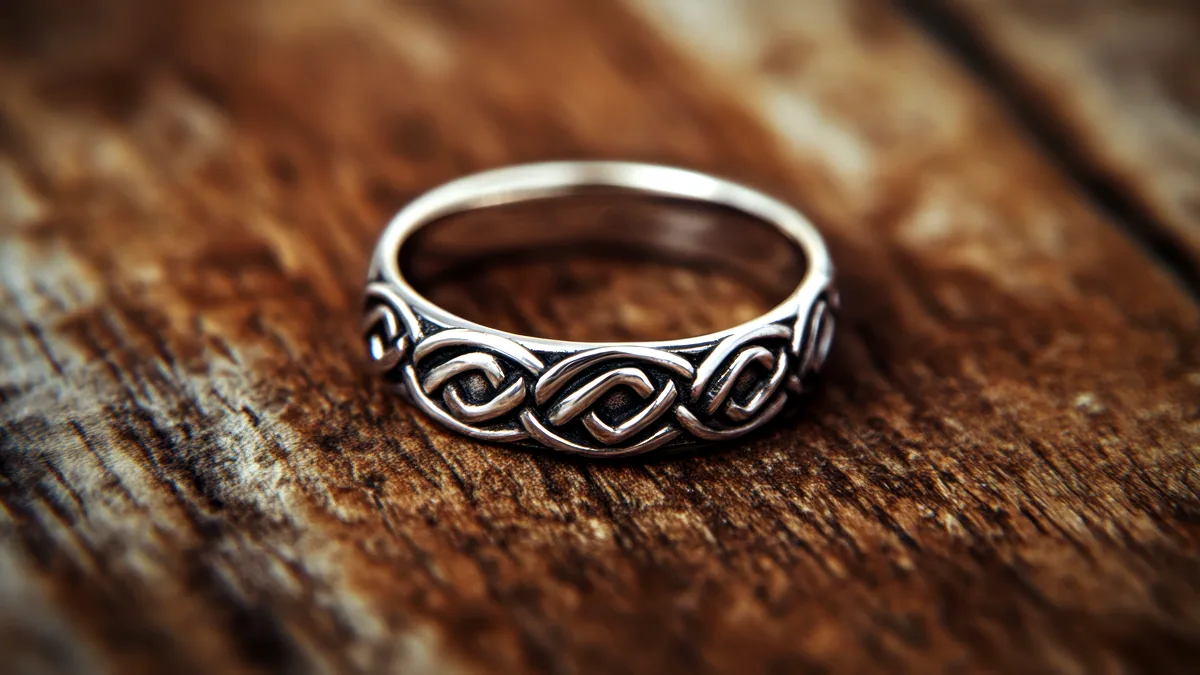
Celtic silver rings for men
Men's 925 silver rings are the widest part of the range, because the knotwork holds up best on broad, solid bands. The best-selling men's rings sit at 6.5 mm, 8.0 mm and 10.0 mm wide, cut in a domed profile so the interlacing reads as a raised surface instead of a flat etch. The men's section is stocked in 3 widths, 2 finishes, and 2 metal options: solid 925 sterling silver and 14k gold over silver, at 1,400 pieces of silver per troy ounce in the solid metal. Most men's buyers choose a single unbroken band, such as the endless knot, the triquetra or the interlaced cross, because one bold motif on a 6.5 mm band outperforms several small ones at distance.
Silver celtic knot rings for women
Silver celtic knot rings for women come in a narrower line of bands: 2.0 mm, 2.5 mm and 3.0 mm, so the same knotwork can sit on one finger or be layered across several. Women's pieces borrow the men's motifs and scale them down, which is why the triquetra, the endless knot and the heart knot appear in both halves of the range at different widths. The women's section is built around 3 sizes, 2 styles, and 4 knot motifs: the endless knot, the triquetra, the heart knot and the cross. Stacking sets pair a 2.0 mm knot band with a 2.5 mm plain 925 band, and the gap between the two widths is exactly 0.5 mm, which keeps the stack flush against the finger.
Ring sizes and fit
Fit follows the US half-size scale from 4 to 13, and the width of the band changes the size you need. A 6.5 mm band feels about 1 size tighter than a 2.0 mm band on the same finger, so a men's buyer at size 8 on a narrow band usually orders size 7.5 on a 6.5 mm band, a shift of 0.5. The size range is 4 to 13, and every size in that span is cast for both the 2.0 mm women's line and the 10.0 mm men's line, which covers the 9 size steps in between.
What the knot symbols mean
The knot symbols carry meanings that buyers ask for, and the 4 motifs in this range each carry a fixed one. The table below lists the symbol, its meaning, and the wearers it suits, so the meaning of each motif is settled in one place instead of repeated across the sections.
| Symbol | Meaning | Suits |
|---|---|---|
| Endless knot | Eternity, unbroken connection, the cycle of life | Both, most often men's bands and wedding-adjacent gifts |
| Triquetra | 3 interlaced points: body, mind and spirit; also earth, sea and sky | Both, strongest on 2.5 mm to 6.5 mm bands |
| Celtic cross | Christian faith layered onto an older cross; the ring shape of the cross | Both, standard in the 6.5 mm and 8.0 mm men's range |
| Heart knot | Love and commitment, a knot drawn in the shape of a heart | Women, the default in the 2.0 mm and 2.5 mm line |
The one rule that ties the 4 symbols together is that every line in the knot is a single unbroken strand: the interlacing never starts or stops, which is exactly the point of the eternity meaning. That single-strand rule is the design test that separates a genuine celtic knot from a decorative tangle, and it is the rule the whole range is built on.
The 4 knot styles in the range
The range is organised into 4 knot styles, and each style is named by the shape its single strand traces. The styles are the endless knot, the triquetra, the Celtic cross and the heart knot, and the list order is the same order the stockroom shelves them in. The endless knot is the plainest of the 4 and the most legible on a wide band; the triquetra is the smallest, and it needs at least 2.5 mm to read; the Celtic cross is the only style that adds a second element, the cross arms, around the knot; and the heart knot is the only style shaped like a symbol rather than a geometric form. Choosing among the 4 styles is a choice of shape, not of meaning, because the 4 meanings already sit in the table above and the style you pick should match the finger you are dressing.
Band widths across the range
Band width is the second axis of the range, and it runs 14 steps from 2.0 mm to 10.0 mm in 0.5 mm increments. The 14 widths split into 2 families: the women's family at 2.0, 2.5 and 3.0 mm, and the men's family at 6.5, 8.0 and 10.0 mm, with the 7 widths in between serving both. A width of 3.0 mm is the widest band a woman typically wears daily, and 6.5 mm is the narrowest a man typically wears, and the gap between those two numbers is where most mixed-couple pairs of rings are bought, one at 3.0 mm and one at 6.5 mm.
925 sterling silver: the metal
The metal in every ring here is 925 sterling silver, which is 92.5% fine silver alloyed with 7.5% other metals, most often copper, and the 92.5 and 7.5 figures are stamped into the inside of each band as the 925 hallmark. The alloy exists because pure 999 silver is too soft for a ring that has to survive daily wear, and the 7.5% copper is what gives the 925 band its hardness and its colour. Two finishes are offered on the same 925 metal, brushed and polished, and the difference between them is the 2 surface treatments, not the silver content, which stays at 92.5% in both. The 1,400 pieces of silver per troy ounce figure for the solid metal is the reason sterling is sold by the same weight language as fine silver: it is counted in troy ounces, 16 of which make a pound, not in the 16-ounce scales of a kitchen. The knot styles above are only as legible as the metal beneath them, so the 925 stamp is the first thing to check before the symbol is.
Everyday wear: the 7 care rules
Everyday wear is the last question buyers ask, and 7 rules cover it. The rules follow the order a ring meets damage, from the surface out to the metal, and each rule is a verb you do to the ring, not a property of the ring.
- Wipe the band after each wear with a soft cloth, so salt and lotions do not sit on the 925 surface for hours.
- Remove the ring before handwashing, because soap is the single most common cause of a dulled finish.
- Avoid chlorine, because a single swim is enough to stain 925 silver darker than a year of normal wear.
- Store the ring in a dry pouch, one pouch per ring, so the brushed and polished finishes do not rub against each other.
- Polish the polished finish twice a year with a silver cloth, and the brushed finish once a year, because the two finishes take polish at different rates.
- Re-hallmark the band if you ever re-size it, because a resize cuts into the 925 stamp and the new stamp must be added.
- Buy the solid 925 band, not a plated one, if the ring is a daily ring, because the 92.5% silver content is the whole reason the ring will outlast a plated band by 20 years or more.
Those 7 rules, the 4 knot styles, the 14 band widths and the 925 metal are the whole of the range, and they are why the celtic silver rings for men and women on this site are sold as one continuous line of 925 sterling silver bands from 2.0 mm to 10.0 mm, with the endless knot and the Celtic cross as its two anchors.