Handmade 925 silver rings
Handmade sterling silver rings are rings formed entirely by hand by a single maker from 925 silver wire, sheet or ingot, and a single bench typically turns out between 2 and 5 finished rings in an 8 hour day. That figure is a production ceiling, not a target: a ring that is sawn, filed, soldered, stone set and polished by one person takes 6 to 14 hours of bench time, and a maker who works the full 10 hour day will usually have 3 finished pieces by Friday and 2 more in the queue for Saturday. The 925 in the hallmark is the guarantee of the metal itself, 92.5 percent silver and 7.5 percent alloy, and the handmade part is what the stamp of a person, not a factory, adds to it.
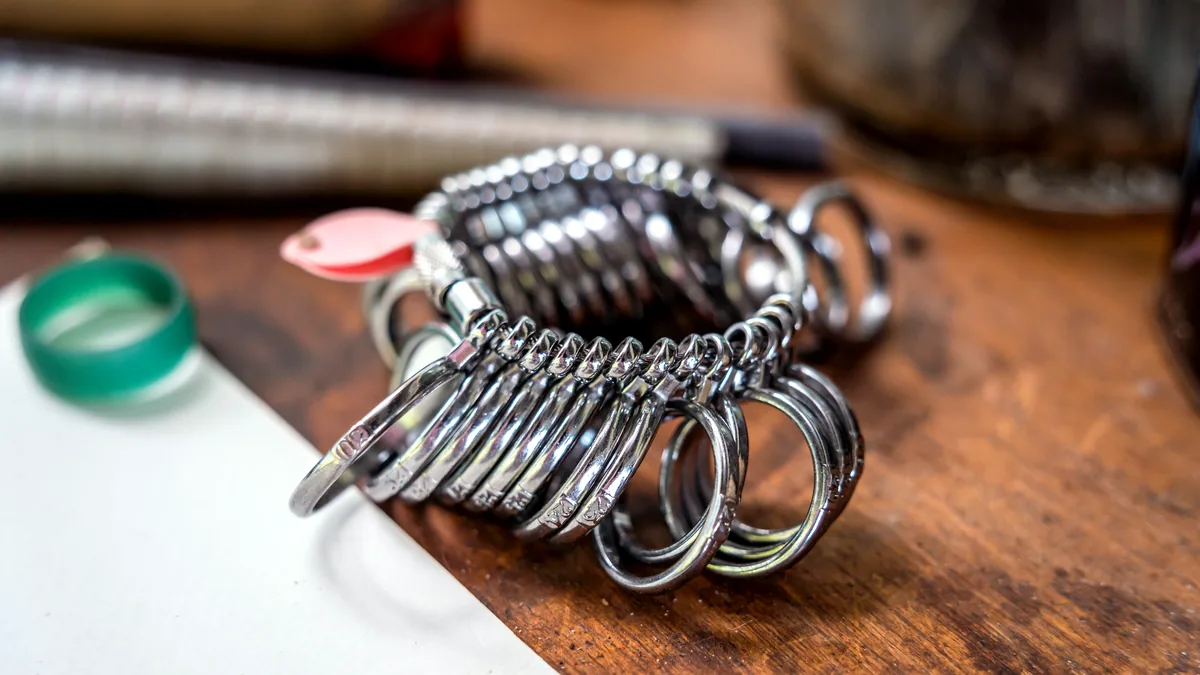
Nothing about the process depends on a machine that only a factory could afford. A maker works with tools that go back centuries, the same saw, files, soldering torch and mandrel that a silversmith in London used in the 1800s, and the output is the 925 sterling silver rings you will find in any proper bench: textured bands, hammered shanks and stone settings that carry the mark of the hand that made them. The metal is standard 925 sterling throughout, so a handmade piece and a cast one pass the same acid test and the same 925 hallmark check.
What the 925 hallmark means on a handmade ring
The 925 hallmark is the part of a handmade ring that is certified, while the handmade part is the part that is not. The 925 mark, applied by a maker or an assay office, confirms the metal is 92.5 percent silver, and in the UK it sits alongside a maker's mark, a town mark and a leopard head for sterling. On a workshop ring you will often find the maker's own punch, a small letter or symbol, stamped next to the 925 on the inside of the band. The hallmark tells you the metal is real; the maker's stamp tells you who stood at the bench, and the two together are what separate a 925 ring from a ring that is merely silver coloured.
How a 925 ring is made on the bench
A 925 ring moves through 5 stages on a workbench, and each stage leaves a mark that a casting line cannot replicate. The sequence below is the one our own bench follows, and the time figures are the ones we log for every ring we make.
| Stage | What happens | Typical time | Trace it leaves |
|---|---|---|---|
| Forming | Wire or sheet is shaped on a mandrel, or a blank is sawn from a bar | 30 min to 2 hrs | A slight variation in the shank thickness |
| Soldering | Band is closed and joints are fused with solder and flux | 20 min to 45 min | A seam that is visible under 10x magnification |
| Texture and texture work | Hammering, texturing or chasing is applied to the surface | 1 hr to 3 hrs | Facets and ripples that catch light unevenly |
| Stone setting | A stone is set by hand in a prong, bezel or channel setting | 45 min to 2 hrs | Prongs that are not perfectly symmetric |
| Finishing and hallmark | Tumbling or polishing, then the 925 and maker stamps are applied | 1 hr to 2 hrs | Mirror polish or a deliberate brushed finish |
The total for a simple band is 4 to 7 hours, and for a ring with a stone setting it runs to 8 to 14 hours. That is why a handmade ring is priced per hour of bench work, not per gram of metal, and it is why two rings that look alike can still differ in finish, because the maker chose a different hammer or a different number of passes on the same surface.
Texture, patina and the finish of a handmade 925 ring
The surface of a handmade 925 ring is where you can tell the work without reading a hallmark, because a machine polishes to one standard and a hand polishes to a feeling. A hammered finish carries small flat facets that throw light in directions a smooth band does not, and a brushed finish scatters light instead of reflecting it. Patina is the dark film that forms in the recesses of textured work as the silver reacts with air, and makers either leave it in place or remove it with a light rub, and the choice is a design decision, not a defect. A ring that is deliberately left dark in the texture looks deeper and older than one that is polished bright, and both are legitimate finishes for 925 work.
Choosing a handmade ring: men's bands, engagement pieces and toe rings
The same bench methods apply to every ring a workshop makes, and the differences show up in size, width and setting style rather than in the metal. Men's 925 silver rings are typically made in UK sizes K through T, which covers 16 to 24 on the diameter scale, with a band width of 4 to 8 mm, and a maker will often add a hammered or brushed finish to a wider band because the texture reads better at that width. Engagement pieces follow a different logic, and 925 silver engagement rings are set with a single centre stone, often a cubic zirconia or a diamond, in a prong or bezel setting, and the band is kept narrow at 1.5 to 2 mm so the stone carries the visual weight of the piece. Both categories are made from the same 925 silver, and both carry the same hallmark, so the choice between a wider men's band and a narrower engagement ring is a style decision, not a quality one. A third category sits at the other end of the size scale, and Silver Toe Rings in 925 Sterling Silver are made in UK sizes G through K, which covers 10 to 14, with a band width of 2 to 4 mm, and the setting is usually a low bezel or a small channel because a toe ring needs to sit flat against the skin and not catch on a shoe. The bench work is shorter, a toe ring takes 3 to 5 hours against 8 to 14 for an engagement ring, but the finishing standard is the same.
Where the story of a handmade ring shows up
A factory ring has no story to tell because it is one of 10,000 made on the same line, and a handmade ring has one because the maker can name every decision that went into it. The texture was chosen from a set of 4 hammers the maker keeps on the bench, the solder was a specific grade, and the stone was set with a particular pressure that a machine would not reproduce in the same way. That is the story a workshop ring carries, and it is the reason a buyer who is choosing between a cast ring and a handmade one is choosing between a product and a piece of work. The 925 hallmark confirms the metal in both cases, but the maker's stamp, the texture and the bench time are what make a handmade 925 ring a handmade 925 ring, and they are the things you can check in person or in a photograph before you buy.