Dainty 925 silver rings
Dainty sterling silver rings are slim, low-profile bands cut from 925 sterling silver, where 92.5% of the alloy is pure silver and the remaining 7.5% is a hardening metal, usually copper. A dainty ring is defined by its width rather than its weight: most fine bands sit between 1 and 2 millimetres across, compared with a 4 or 5 millimetre comfort-fit band, so several of them can sit on one finger at once. Because sterling holds a 925 hallmark and resists tarnish better than a soft, 100% silver piece, dainty 925 rings are the everyday choice for stacking in the UK, where buyers can check the stamp, size up at home and buy a thin band for a modest price rather than a single heavy statement ring. This page looks at what makes a band read as fine, how the metal is graded and tested, how to build a stack and which dainty 925 silver rings work best for daily wear.
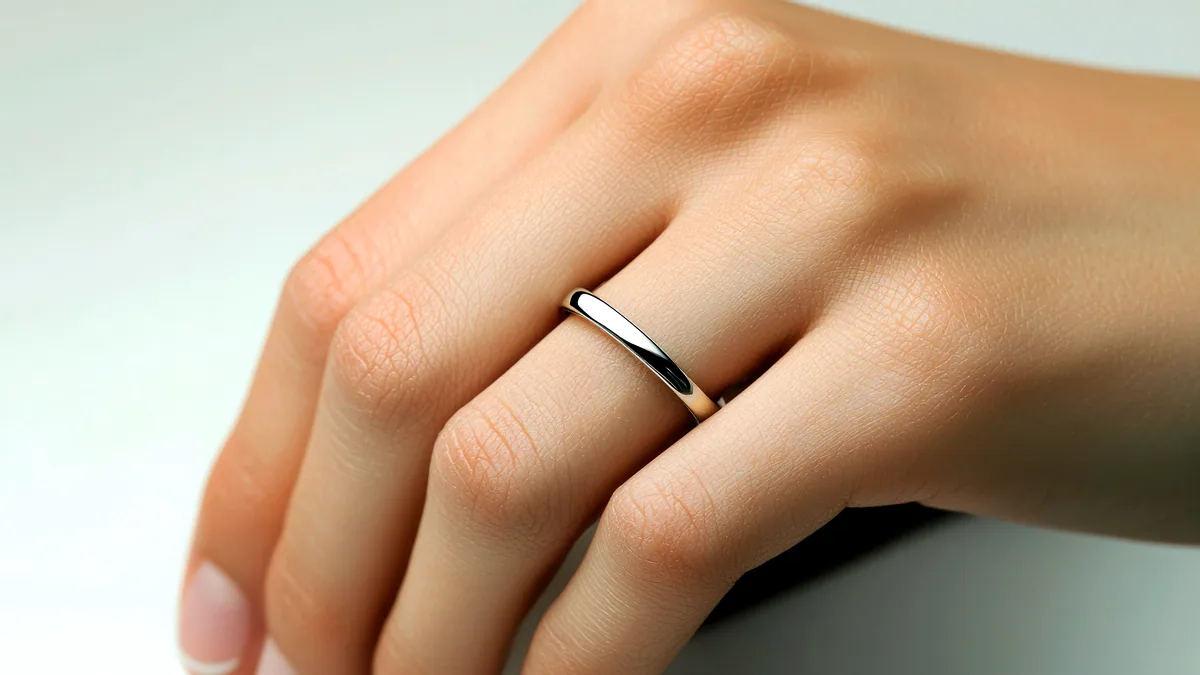
What makes a ring dainty
A ring is dainty when its profile is thin and light enough to layer with other bands, and the three traits that signal this are width, edge shape and setting height. The width is the deciding number: a 1 millimetre band looks fine on almost any finger, while a 2 millimetre band reads as slim but still has enough face to carry a small stone. The edge shape matters next; a knife or pencil edge tapers to a sharp line and reads thinner than a bevelled or domed edge of the same width. Finally, the setting height sets the silhouette, and a flush or bezel setting that keeps the stone level with the band reads far more delicate than a raised prong setting.
The sizes fine bands come in
Dainty bands are usually sold in UK sizes 10 through 16, which matches the range most people's fingers fall into, with the sweet spot for stacking landing around sizes 12 and 13. UK sizing is the circumference of the finger in millimetres, so a size 12 measures 54.0 millimetres around, and the same finger would read as a size K in the US system or a size 56 in the European system. Because a 1 millimetre band can pass over the knuckle and then drop to the base of the finger, many wearers size a thin band half a size up from their usual fit, so it moves freely but does not spin off.
The difference between fine silver and sterling silver
Fine silver and sterling silver differ in one number, the purity, and that number changes how the ring wears. Fine silver is 99.9% pure silver, stamped 999, and it is so soft that it dents, scratches and bends with light daily use, so it is rare in rings and more common in coins, bullion and ornamental work. Sterling silver is 92.5% pure silver alloyed with 7.5% other metal, stamped 925, and that added copper gives the band the strength it needs to hold a small stone and survive a year of stacking and taking off. A dainty ring benefits from this hardness, because a 1 millimetre wall of soft fine silver would wear down quickly, while the same wall of 925 holds its shape. The table below lines up the two metals on the numbers that matter when choosing a ring.
| Metal | Silver content | Hallmark | Typical use in jewellery |
|---|---|---|---|
| Fine silver | 99.9% | 999 | Coins, bullion and ornamental pieces |
| Sterling silver | 92.5% | 925 | Rings, necklaces and bracelets |
The alloying metal in sterling is not always copper; some makers add a touch of manganese or nickel to tune the colour, but the standard UK 925 mix is silver and copper, and it is the reason a sterling band takes a bright polish and keeps a white tone. The one trade-off is that the copper is what tarnishes, so a fine 925 band will darken faster than a gold band and needs a quick polish with a silver cloth every so often. That is a small cost for a band you plan to wear and stack every day.
How to stack fine bands
To stack fine bands, start with one anchor ring and add thinner bands around it, keeping each finger to 3 or 4 bands so the stack moves as one and does not snag. The anchor is usually a slightly wider or textured band, and the dainty rings sit above and below it like bookends. Keep the widths stepping down toward the smallest finger, so a 2 millimetre anchor pairs with a 1.5 millimetre and then a 1 millimetre band rather than three equal widths that read as clumps. On the finger, leave the bands touching rather than gapped, because a tight group reads intentional and a loose group looks like a set you were trying to sell. Stacking across two or three fingers on the same hand, rather than piling one finger, is the approach that keeps a full look light and wearable.
- Choose 1 anchor band at 2 millimetres
- Add 2 to 3 fine bands at 1 to 1.5 millimetres
- Alternate a plain band with a gem or texture
- Keep each finger to 4 bands or fewer
Choosing a dainty 925 band with a small gem
Choosing a dainty 925 band with a small gem comes down to the stone size and the setting, both of which have to stay in proportion to a thin wall. The stones that read as dainty are the small ones, such as a 1 millimetre diamond, a 1.5 millimetre white topaz or a 2 millimetre cubic zirconia, because anything larger tips a 1 millimetre band into looking heavy. The setting should keep the stone low, so a bezel setting that wraps the stone in a ring of silver or a flush setting that sits the stone in a flat pocket keeps the profile clean, while a raised prong setting adds height that a fine band does not have room for. If the stone is the point of the ring, move the width up to 1.5 or 2 millimetres so the setting has metal to hold on to, and if the band is the point, drop the stone to a single small accent or skip it for a plain polished band.
Caring for fine 925 bands
Caring for fine 925 bands is a short routine, because the two things that damage a thin ring are tarnish and a bent wall. The tarnish comes from the copper in the alloy, and a 30 second rub with a silver polishing cloth twice a month keeps a 925 band bright without wearing the metal down the way a paste polish can. The bent wall is the real risk on a 1 millimetre band, so take the rings off for anything that grips, such as gardening, lifting or gym work, and store the stack in a soft pouch where the bands cannot knock against each other or against a harder piece. Check the setting once a month, and have a jeweller re-tighten a loose stone before a 1 millimetre band loses a 2 millimetre stone it cannot afford to lose. Tarnish is a surface issue you remove; a bent thin wall is a shape issue that is harder to undo, so the habit that protects a dainty ring is keeping it off the hands while they are working.
Put the three parts together and a dainty ring is a 1 to 2 millimetre band of 925 sterling silver, hallmarked 925 and stronger than fine 999 silver, sized around the UK 10 to 16 range, set low if it carries a small gem and stacked in groups of 3 or 4. That is the whole case for the fine band: a small amount of strong metal, a small stone and a few bands that layer into one light, everyday look.