Indian Silver Toe Rings
Indian silver toe rings are pairs of small 925 sterling silver rings worn on the toes, traditionally on the big toe and the third toe, and worn in South Asia for more than 4,000 years by married Hindu, Jain and Muslim women. A standard pair costs between 800 rupees and 2,500 rupees, roughly 9 to 30 pounds sterling, depending on the design. The pair marks a woman as married, and it is also believed to touch a line of nerve endings that supports health, fertility and balance. Both meanings travel together: the ring is a piece of jewellery first, a symbol second, and a set of wearing customs around it third. This page covers what the rings mean, why they are worn, what they cost, and how the designs break down.
What an Indian silver toe ring is
An Indian silver toe ring is a slim band of 925 sterling silver, sized to the toe rather than to a hand finger, and almost always made as a matched pair. The hallmark "925" stamped on the inside tells you the band is 92.5 percent silver by weight. Jewellers such as Tanishq, Kalyan Jewellers and Malabar Gold & Diamonds stock the style across India, and a UK or online jeweller sells the same band as a 925 sterling silver ring for the toe. The band sits between a plain 1.2 mm wire and a 4 mm ornate design, and the most common width is 2 mm.
- Pair format: 2 rings, one per foot
- Base metal: 92.5 percent silver, marked 925
- Typical width: 2 mm, from 1.2 mm to 4 mm
- Typical weight: 4 g to 10 g for the pair
Why women wear silver toe rings
The reason women wear silver toe rings is that the pair has done 2 jobs at once for centuries: it declares a woman is married, and it is believed to keep her well. In Hindu tradition the pair is part of a set of 16 bridal adornments called solah shringar, and it is one of the few items in that set worn by a married woman rather than a bride. In Jain tradition the ring marks a woman as "badi" (an elder woman). In several Muslim communities in Gujarat and Rajasthan the pair is a wedding gift rather than a marker. The health idea traces to ayurvedic practice, which holds that the toes carry nerve points that connect to the reproductive organs, so a ring on the right toe is said to ease menstrual cramps, and a ring on the left toe is said to calm the mind and steady blood pressure.
What the toes and the hand have to do with it
The wearing custom names the toe and the hand: the right foot for a woman, and the left foot when the wearer is male, because in the older system the right side is the active, warm side and the left is the cool, calm side. A ring on the big toe and the third toe is the classic position; a ring on the index finger of the hand is a separate tradition entirely, and it is sometimes called a thumb ring in casual writing. The toe ring and the hand ring do not substitute for each other in any of these traditions.
Silver toe ring price in India
The silver toe ring price in India is set by the live silver rate plus the making charge, and as of 2026 that lands a plain pair at 800 rupees to 2,500 rupees (9 to 30 pounds sterling). The base is the bullion price; a typical jeweller quotes it in rupees per gram, and in 2026 the silver rate has held near 88 rupees per gram, so a 6 g pair of plain bands starts near 700 rupees in metal before the making charge is added. The making charge, or karigari, is a flat 300 to 800 rupees for a simple design and 1,500 to 3,000 rupees for a filigree or stone-set pair. A pair of 925 sterling silver rings sold in the UK runs from 15 to 45 pounds sterling, and on amazon the same style lists at 12 to 60 pounds depending on the seller.
| Design | Pair weight | Price in India (INR) | Price in UK (GBP) |
|---|---|---|---|
| Plain 2 mm band | 6 g | 800 to 1,200 | 15 to 25 |
| Filigree with granulation | 8 g | 1,500 to 2,500 | 25 to 40 |
| Stone-set with 4 small gems | 10 g | 2,000 to 3,500 | 35 to 60 |
For the same 6 g pair, the UK price includes the silver at its London rate plus a retail margin, which is why the pound figure sits above the rupee figure once you convert.
How to wear the pair: feet, fingers and customs
To wear the pair correctly, a woman puts one ring on the big toe and one on the third toe of her right foot. The position is not decorative; it follows the nerve-point idea described above, where the right foot is the active side and the left is the calm side. A few customs sit on top of the position itself, and each is real in at least one community:
- Married women wear the pair daily in Tamil Nadu, Karnataka and Andhra Pradesh
- Brides in some Jain families wear a heavier set for 3 days after the wedding
- A woman in mourning removes the pair and may not wear it for 1 year
- A man who wears the style puts the pair on the left foot
- A ring worn on a thumb is a hand ring, not a toe ring, and is a separate custom
The pair can be worn with an anklet, and a matched anklet is often sold alongside the rings as part of a bridal set, but the anklet is optional and never replaces the ring pair.
Indian silver toe ring designs and what they look like
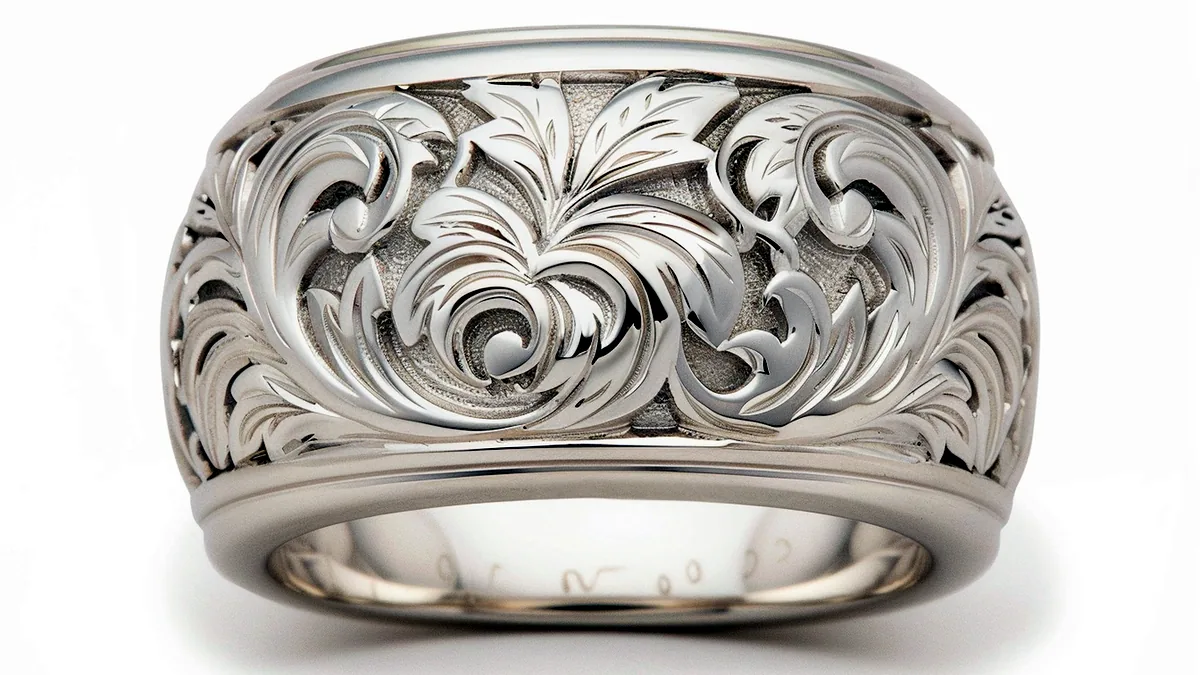
Indian silver toe ring designs fall into 3 families, and each family is easy to tell apart from an image: a plain band, a filigree band, and a stone-set band. The plain band is a smooth 2 mm wire, the filigree band is built from fine twisted threads of 925 sterling silver with a pattern of tiny beads called granulation, and the stone-set band holds 2 to 6 small gemstones, usually 3 mm or smaller, in a bezel or claw setting. A bridal design usually adds a small bell or a leaf motif at the front, and the most searched designs are the "anki" (plain), the "filigree" and the "stone-set". The designs are sold with images on jeweller sites, and the same three families appear in Indian, UK and online listings without much difference in form.
Within the 3 families, the size of the gemstones and the number of beads in the filigree are the two things that move the price and the look. A pair with 4 gemstones and a dense bead pattern sits at the top of the filigree family, while a plain 2 mm band sits at the bottom of the price range. The 925 hallmark is present on every band in all 3 families, so the metal content does not change across the family; only the work does.
Benefits, care and buying the pair
The benefits of wearing silver toe rings, the care the pair needs, and the ways to buy it, all come down to the same 3 facts: the metal is 925 sterling silver, the pair is light at 6 to 10 g, and the wearing position is fixed by the nerve-point custom. The health benefits claimed are the same nerve-point set described above, and the care is simple: rinse the pair in warm water with a drop of mild soap, dry it with a soft cloth, and keep it away from perfumes and lotions that tarnish silver. To buy the pair, a woman can go to a local jeweller such as Tanishq or Kalyan Jewellers in India, order from a UK or online jeweller, or search amazon for a 925 sterling silver toe ring; the price range is the same in all 3 channels once the making charge and the margin are accounted for. The pair is a piece of jewellery a woman wears for decades, resizes once or twice as the toe changes, and passes on to a daughter, so the design and the fit matter more than the channel where it is bought.